Our School
Die Schlachtschule teaches the arts of foot combat appropriate for a medieval European
knight, whether they were used for sport or in earnest.
Why study ancient arts of combat? Why resurrect these lost arts in the 21st century?
Each student must answer those questions for himself, and yet there is a real fascination in most of
us about the Middle Ages and the knights who lived in that violent and bloody time. Martial arts in
general give us a focus and discipline in our lives, and medieval martial arts in particular give us a
connection to a culture that many of us find fascinating and important.
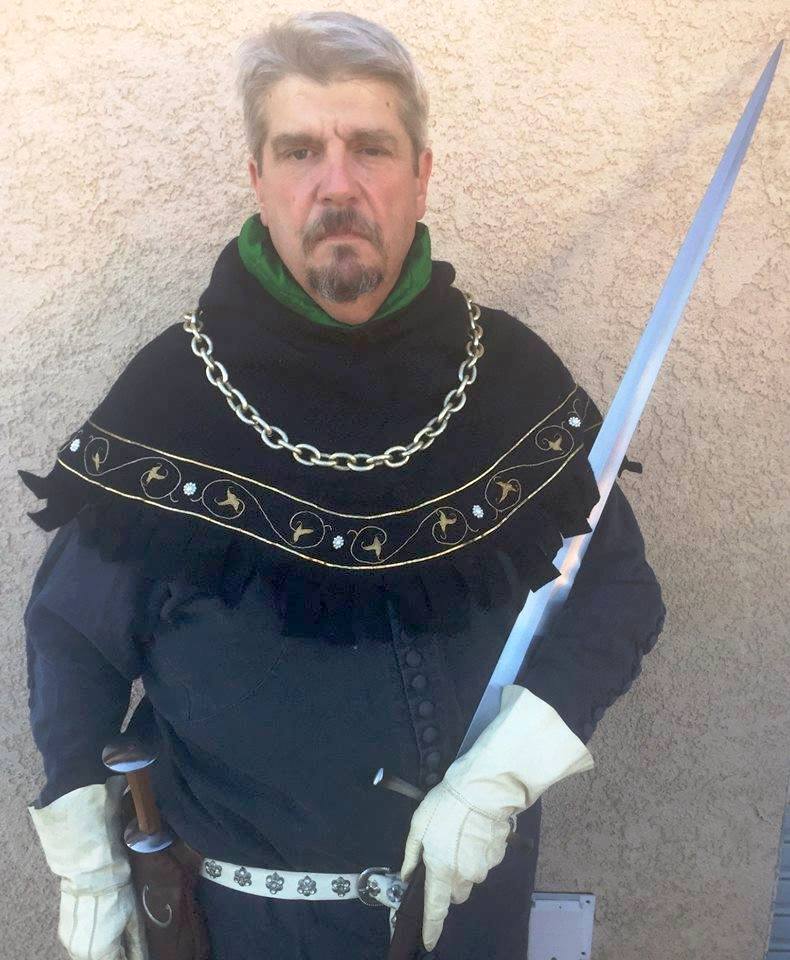
Fechtmeister
Hugh Knight
(e-mail)
has been studying medieval history and culture for more than
twenty years, especially the combat arts. He collects medieval artifacts
and reproductions, especially armor and weapons, and practices many of
the skills appertaining to medieval knighthood. He is a licensed
falconer, has ridden to the hounds, has a brace of greyhounds that he
uses to course game, and, of course, practices medieval combat skills in
armor and out. His study of medieval fencing manuals began almost ten
years ago with Le Jeu de La Hache, and has continued ever since. He is
currently working on a book about armored combat in the Middle Ages. He
lives in California with his hawk and his hounds.
Our Focus
The term "medieval" is a slippery one, and even professionals disagree somewhat as to its precise
temporal definition.
The earliest fencing manual extant is called "I. 33" and dates from the end of the
13th century: this gives us a starting date for our study.
By the late 15th century the use of peasant
foot soldiers armed largely with pole-weapons (and not gunpowder as so many, even professional
historians, believe – the fully-armored knight was replaced long before individual firearms saw much
use on the battlefield) had forced the armored knight from his place of pre-eminence on the
battlefield. Since the purpose of die Schlachtschule is to study and teach the arts of combat
appropriate to the knight, that serves to give us our ending date. So we will focus on the fencing
manuals dating from the 13th through the late 15th centuries.
There were two main schools of combat in our period: the German and the Italian. While there
are some similarities between the two schools, there are major differences of philosophy.
Many modern students of medieval martial arts tend to combine the teachings of both schools in
their studies, but this, we believe, lessens the effectiveness of each, especially since some of their
ideas are antithetical. That being the case, we have chosen to limit our curriculum to only one, and
for a variety of technical reasons we have chosen the German school (although one of our major
sources is Burgundian, it shows a direct connection to one of the German master’s teachings, as
you will see below).
Thus, the focus for die Schlachtschule is German fechtbücher from
the 13th through the 15th centuries.
The Scope of Our Study
Modern fencing scholars have taught that the arts of combat as practiced before the Renaissance
were crude and unskilled when compared to the supposedly more "refined" arts of the rapier, but
nothing could be farther from the truth. In fact, medieval martial arts were refined, elegant and
comprehensive. They resembled the ancient Japanese martial ryu or "schools" of combat in which
the bushi or samurai would train in a variety of arts, such as the sword, wrestling, the spear, the
knife, etc., to become accomplished, all-around warriors. Medieval masters were just as
concerned about having their students learn all of the arts appropriate to the day, teaching all forms
of combat from wrestling to dagger to sword and buckler to longsword to pollaxe, and teaching the
ways of fighting both in and out of armor. Moreover, they taught complete systems
of combat, not
just disparate tricks. Their works included instruction in the strategy and tactics of combat as well
as the techniques themselves.
Die Schlachtschule attempts to match those ancient schools by
teaching a complete system of medieval foot combat, both armored and unarmored.
Medieval combat could be broken into three categories: Blossfechten, Harnischfechten and
Rossfechten, or unarmored, armored and mounted combat respectively. Due to the expense and
rarity of horses in our modern world we have elected to limit ourselves to foot combat at this time.